
DPW — Daitai Programmers Workshop
A complete, algebraically grounded development environment for an era when software is written by AI but must be proven by humans.
Code Daimyo IDE — built from the ground up without React, with its own UI framework, its own language, and its own algebra.
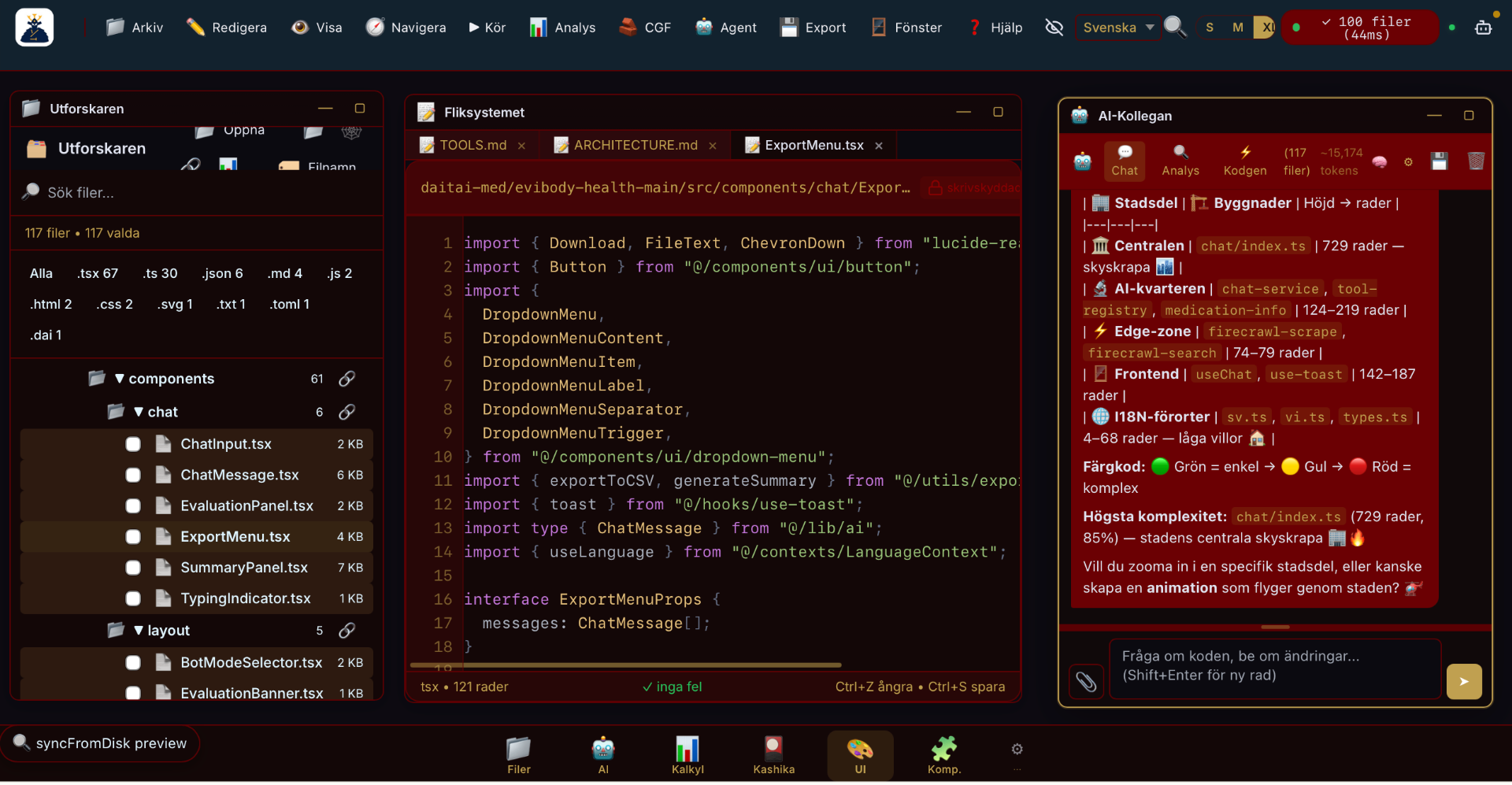
DPW · Underwater theme · Swedish locale · AI-Kollegan with CodeCity context
What DPW is
DPW (Daitai Programmers Workshop) is a web-based and native development environment that combines:
- Code editing with syntax support for HTML, CSS, JavaScript, TypeScript, and our own language daitai-lang
- Spreadsheet with formulas, charts, pivot tables, and graph visualization
- Kashika — presentation tooling with slides and a shared selection engine
- UI Editor — drag-and-drop with an algebraic layout model
- AI Colleague — integrated AI assistant with context awareness, tools, and a verification policy
- DaitaiDB — document database with a graphical interface
- Terminal and Git — built-in terminal plus staging and commit handling
- OCR — our own recognition engine (NCC + LeNet), independent of any third party
Everything is rendered with daitai-ui, a self-built component framework with no React dependencies in the core.
Why DPW exists
The 2026 climate rewards speed over rigor. AI-generated React slop ships faster than compliance teams can review it. DPW is the constructive alternative:
- Verifiable instead of assumed — algebraic invariants (P01–P23) that LLM output can be validated against
- Provider-neutral instead of locked in — Tauri offline-first, swap AI providers at no cost
- Signed instead of documented — CGF turns compliance into a cryptographically verifiable artifact
- Pedagogical instead of magical — every line has a derivation, every commit a signature
Architecture in five layers
1. SURFACE      Editor · Kashika · Spreadsheet · UI Editor · AI Colleague · DaitaiDB
2. FRAMEWORK    daitai-ui (mount/reconciler/reactive) · SelectionEngine · PubSub · 23 themes
3. CORE         daitai-lang · daitai-algebra (P01–P23) · CEA (256D vector index) · CGF
4. AGENT        Executor · Checkpoints · Verify build · Typed diagnostics · Approval gates
5. PLATFORM     platformIO → Tauri | Web | Hosted
Each layer talks downward through clean interfaces. No layer leaks upward. See the dedicated Architecture page for layer-by-layer detail.
Features — overview
- Editing — Multi-language CodeEditor; syntax highlighting; ghost-text completion; type-directed holes; semantic selection across DOM/AST/Tailwind/Theme
- Spreadsheet — Formulas, charts, pivot tables, graph view with minimap, CEA-driven code analysis in sheets
- Presentation — Kashika with slides; CanvasAdapter for SelectionEngine; auto-export
- UI design — Drag-and-drop, snap & guides, VStack/HStack algebra, DOMAdapter
- AI — AI Colleague with tool registry, prompt evals, memory graph, mandatory verification policy
- Agent — Multi-step executor, trajectories, time-travel, fork-retry, checkpoints
- Compliance — CGF, signed
.cgfevidencebundles, EU AI Act, GDPR, SOC 2, APPI/METI/FSA (JP) - File system — platformIO over Tauri / Web (localStorage + IDB) / Hosted
- Git — Built-in staging, commit, stash-based checkpoints
- Terminal — ProcessRegistry-streamed shell, shell-policy whitelist/denylist
- Database — DaitaiDB document database with a graphical UI
- OCR — NCC + LeNet, no third party
- 3D — Three.js facade, CodeCity with InstancedMesh for repo visualization
- Build — Multi-pipeline builder via
compileInWorker,daitai.project.json - Tauri —
dpw scaffold tauri, idempotent v2 packaging - Devcontainer — scaffold of
.devcontainer/via platformIO
Core modules in detail
daitai-ui — our own UI framework
A complete component framework written in TypeScript. No React dependencies in the core.
- mount / reconciler / reactive — our own primitives for rendering, diffing, and reactivity
- Trait system —
Clickable,Hoverable,Focusable,Draggable,Resizable - Components —
Button,Input,Progress,Card,HudCard,Dialog,Tooltip,Tabs,CodeEditor,Spreadsheet,Kashika - Theme system — 23 distinct themes (Frost, Samurai, Geisha, Kawaii, Material, Klingon, Underwater, and more)
- VStack/HStack algebra — layout as composition, not CSS-flex tricks
- Slim / Pro / registry — packaged for external use (MIT)
daitai-lang — our own language
A deterministic language with Dirac notation and algebraic data types.
- AST, lexer, parser, scoped Hindley–Milner inference
- Hover information, language-service trait
- Integrates with
CodeEditorvia theuseDaitaiflag - Hole-driven editing: typed holes suggest completions
- Type-directed completion, semantic analysis
daitai-algebra — the axiomatic foundation
Hilbert spaces, quantum sorts, bra-ket syntax. P01–P23 codify invariants that the whole system rests on.
CEA — Code Entity Analysis
256-dimensional hierarchical vector representation of code. Powers retrieval, prompt context, and code understanding.
SelectionEngine
A shared selection engine between UI Editor (DOMAdapter) and Kashika (CanvasAdapter). Adapter pattern via HitTestAdapter. Semantic selection across parallel layers: DOM, AST, Tailwind classes, and theme.
PubSub
Bounded FIFO with backpressure. First-class principle for all inter-module communication. WebWorker bridge. Inspector with ring-buffer logger and debug panel.
platformIO
An abstract I/O interface that all user file handling goes through. Implementations: Tauri (native FS), Web (localStorage + IndexedDB), Hosted (cloud, forthcoming).
The AI Colleague
Not a chatbot — a colleague with tools, memory, and a duty to verify.
- Provider-neutral — Anthropic, Google Gemini, OpenAI, DeepSeek
- Tool registry —
apply_patch,run_shell,verify_build, and more - Memory graph — nodes and edges on top of a memory store, Jaccard derivation, BFS in
buildMemoryContext - Prompt evals — automated test suites for prompt quality
- AI bundles — Tauri-only file-bundle uploads to Anthropic/Gemini Files APIs
- Mandatory verification policy — typecheck runs automatically after file-mutating tool calls with adaptive scope (single/multi/core)
- Determinism requirement —
idgen()andclock()are injectable,Math.random()is forbidden in component code
Agent mode
Multi-step execution with a full audit trail.
- Executor + tracker — linear step execution with outputs, log, and timeline
- Trajectories — JSONL event stream persisted in
.dpw/agent-trajectories/ - Time-travel — headless CLI for replay, seek, and restore
- Checkpoints — auto-snapshot via
CheckpointManager(git stash +refs/dpw-checkpoints/) apply_patch— registered tool with diff-preview bridge and watch modeforkRetryStep— auto-retry of an inner step with checkpoint restore andmutateOnRetry- Typed diagnostics —
classifyDiagnostic+summarizeForRetryfeed the retry loop with structured errors verifyBuildStep— project or single-file typecheck that feeds diagnostics back into the loopchainStep— atomic chain that aggregates child diagnostics- Approval gates —
autoby default, plus inlinerequestApprovalwith shell-policy whitelist/denylist - Project context — graph-derived selection (BFS forward + reverse) with RAG fallback
CGF — Code Governance Framework
Sign your compliance the way you sign your code.
ingest  →  check  →  bundle  →  verify
graph      claims    signed     cryptographic + policy invariants
                     .cgfevidence
- Typed event-driven compliance graph — 15 node types, 16 edge types
- UUIDv5-derived idempotency — same input yields the same graph
- Ed25519 multi-signer signing + RFC 3161 timestamping
- Trust Store — export/import across machines
- Bundle Inspector + Creator UI with drag-and-drop
- Policy presets — Open, Minimal trust, EU AI Act high-risk, Banking grade
- CGF-JP — Japan overlay with ringi/hanko/nemawashi nodes, METI/APPI/FSA/AISI claim packs, bilingual narrative
cgf doctor— end-to-end health check- 206/206 tests passing in v1.0
cgf ingest && cgf check && cgf bundle --out dossier.cgfevidence
cgf verify dossier.cgfevidence
Read on: CGF in 5 minutes, Bundle format, Trust policy.
Workspace models
- Desktop — Native FS via Tauri. Offline-first, full capability.
- Web — localStorage + IndexedDB. Browser, import/export, no install.
- Hosted — Cloud-based (forthcoming). Persistent, collaborative.
All three speak the same platformIO interface. Code written once works everywhere.
Themes and aesthetics
23 rich themes, each with a distinct character — not 23 variations of blue. Default: Underwater.
Frost · Samurai · Geisha · Kawaii · Material · Klingon · Underwater · and 16 more.
The theme system is algebraic: colors, typography, and spacing are exposed as semantic tokens. No hardcoded hex values in component code.
Who it's for
- Students who refuse to learn "prompt craft" as a substitute for understanding
- Enterprise that must deliver proof of compliance, not just documentation
- Regulated industries — banking, finance, medicine, defense — where "same input → same output" is a legal requirement
- Japanese organizations — CGF-JP is not a translation but a native profile
- AI product teams under the EU AI Act who need verifiable Article 9/13/15 evidence
- Auditors who want a diff, not a binder
Sound principles (P01–P23)
DPW is built on a short manifest:
- P01 Determinism — same input → same output, always
- P02 Immutability — all data unchanged after creation
- P03 State → Event → State — algebraic state machine
- P04 PubSub — loosely coupled components via a message bus
- P05 PAL/IO Boundary — pure logic separated from side effects
- P06
Result<T,E>— explicit error handling, no exceptions - P07 Composition over inheritance
- P08 Separation of View / Logic / Mount
- P09 Pseudocode header — every file begins with a daitai spec
- P10 Typed events with a
kinddiscriminator - P11 Testable logic without the DOM
- P12 CEA inspection of code complexity
- P21 HMR — state-preserving via PubSub
- P22 Accessibility — ARIA and keyboard mandatory
- P23 i18n — signal-based reactive translations
(P13–P20 reserved for expansion. Full text on The principles.)
Tech stack
- TypeScript 5, Vite 5, Tailwind CSS v3
- daitai-ui — our own framework, no React in the core
- Tauri v2 for desktop packaging
- Lovable Cloud for hosted backend (where applicable)
Version
v1.06 — April 2026. 206/206 CGF tests passing. Tauri target Phase 1 complete.
Daitai Programmers Workshop — Joakim Cöster + AI Colleague. Code Daimyo: Where algebra meets alignment. Read next: Architecture · Install DPW · Principles.